

Being cross-examined is not an ordinary conversation, it can be one of the most psychologically demanding experiences you will go through in your life.
You may be answering questions about your children, your parenting, your home, your finances, your relationships, your integrity, or the future you have been fighting to protect.
You may be expected to remember important details while someone challenges your account.
You may be interrupted, questioned repeatedly, or faced with suggestions that feel unfair, inaccurate, or deeply personal.
And, underneath all of that, you may be carrying an enormous fear:
What if the pressure stops me from being able to say what I need to say? What if I don’t articulate myself properly when it matters most?
The Aim Is Not To Turn You Into A
“Perfect Witness”
It is to help you remain the best version of you.
This programme is designed to help you:
- Stay psychologically grounded when questioning becomes challenging.
- Recognise your individual stress response before it takes over.
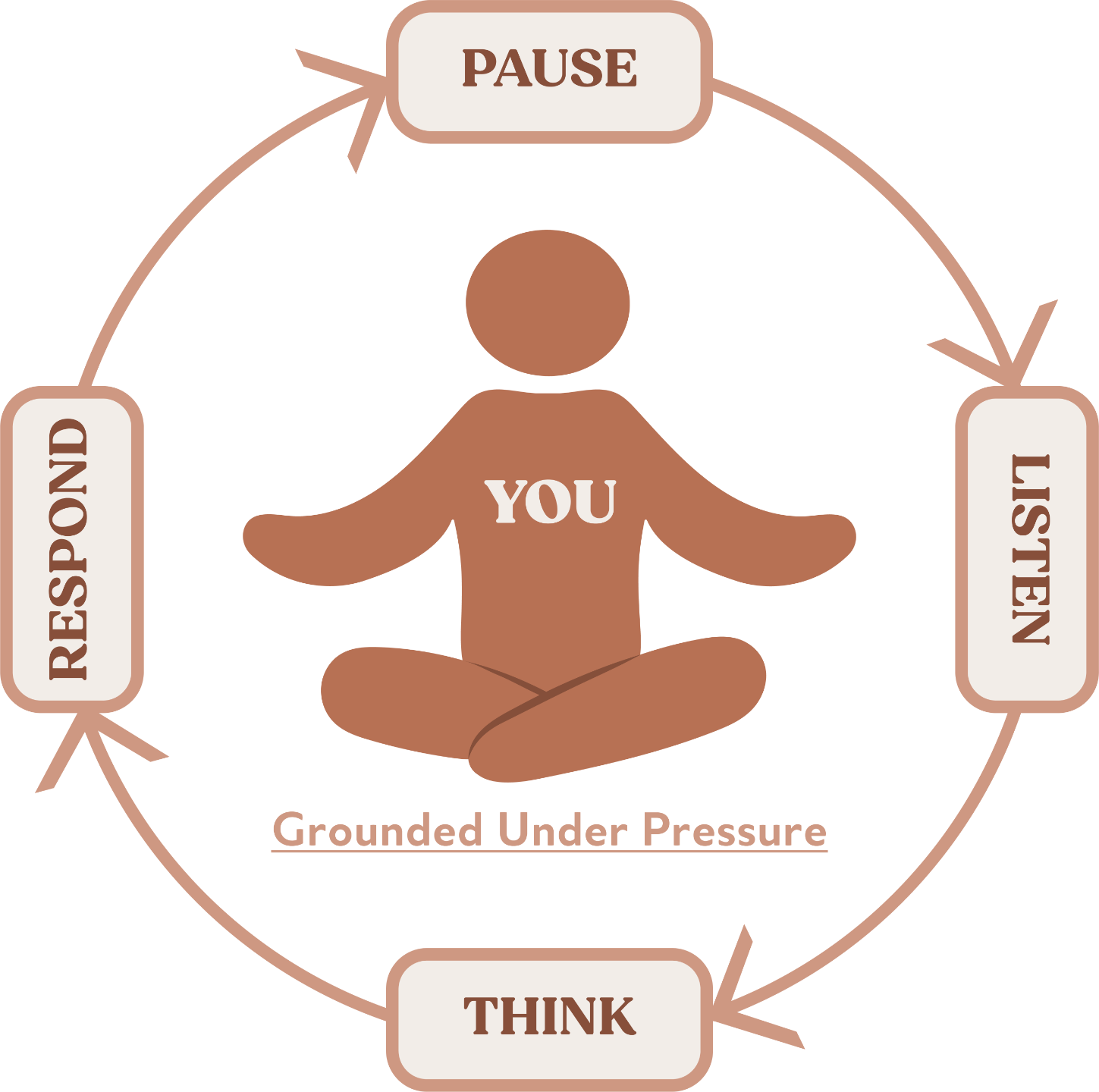
- Create enough internal space to listen to the exact question being asked.
- Pause and think without feeling that you must respond immediately.
- Ask for a question to be repeated or clarified when you genuinely need it.
- Communicate honestly, directly and in your own words.
- Avoid being pulled into rushing, appeasing, arguing or over-explaining.
- Recover more quickly when something activates or unsettles you.
- Maintain your internal pace, even when the questioning feels fast or forceful.
- Present with greater steadiness, clarity and self-possession.
You cannot control the barrister's questions, the court's timetable, or the eventual outcome...
But you can strengthen your ability to control how you present yourself. Your ability to listen to forceful or triggering questions, stay grounded, pause, understand, and then answer with clarity and confidence.
Why Pressure Can Change The Way You Think
When your brain perceives threat, it does not always prioritise thoughtful, reflective communication.
Your attention may narrow. Your body may move into fight, flight, freeze or appease. Words that felt accessible may suddenly become harder to retrieve. You may speak too quickly, lose your train of thought, become unusually defensive or feel emotional.

Research indicates that stress and anxiety can affect the retrieval of memories.
Acute stress can affect working memory, and stress occurring around the point of retrieval can impair access to memories. Anxiety is also associated, on average, with reduced working-memory performance.


These responses do not mean that you are weak, dishonest, or incapable. They mean that your nervous system is responding to a situation it perceives as threatening.
And not everyone responds in the same way...
One person may speed up and say too much.
Another may freeze and struggle to find words.
Another may become overly combative.
Another may agree too readily in an attempt to reduce the tension.
Another may appear calm externally while becoming increasingly confused internally.
This is why this is not a generic course filled with one-size-fits-all courtroom tips. Your preparation begins with understanding your particular brain's response to pressure and how to manage it.
Preparation Built Around You
Not a mass-produced course. Not generic advice. Not a script.
Before our intensive work begins, you will complete a structured psychometric assessment. This gives us a deeper, more systematic understanding of the psychological and interpersonal patterns that may become relevant when you are under pressure during cross examination.

Your assessment is considered alongside Hannah's clinical formulation to explore areas such as:
- How you tend to process conflict and interpersonal threat.
- Whether you are likely to rush, freeze, appease, withdraw or fight back.
- How stress affects your attention and communication.
- The earliest signs that you are becoming dysregulated.
- The situations or styles of communication most likely to activate you.
- What helps you return to clear, grounded thinking.
- Which regulation strategies are most appropriate for you.
- How you can recover when you are knocked off balance.
The assessment is NOT used to label or diagnose you.
It allows the programme to be built around your individual brain wiring
rather than asking you to fit yourself into a standardised formula.
Why Work With Hannah Strong?
Your preparation will be led personally by Hannah, not delegated to a generic trainer or delivered through a pre-recorded course.
Hannah is a leading BACP-accredited psychotherapist and the Clinical Director of My Thriving Child. Her clinical work specialises in supporting parents and children through separation and divorce, including the emotional pressure, uncertainty and high-conflict dynamics that can accompany family proceedings.
She brings together:
- Specialist psychotherapeutic experience.
- A deep understanding of emotional regulation and stress responses.
- An interpersonal-neurobiology-informed approach.
- Extensive experience supporting families through separation and divorce.
- An understanding of psychological realities surrounding family proceedings.
- Collaborative experience working alongside family lawyers and barristers.
- Individualised work shaped around the person, not simply the court process.

Hannah's work is deliberately different from that of your solicitor or barrister.
Your legal team prepares the law, evidence and legal strategy.
Hannah prepares your psychological capacity to remain present while that work is tested under pressure.
Her work complements your legal preparation; it does not replace or interfere with it. Hannah can work hand in hand with your solicitor or barrister where necessary.
What Is Included
1. Your individual psychometric assessment
Before your first intensive session, you will complete a structured psychometric assessment.
Hannah will review and interpret the results as part of your individual psychological formulation.
This provides a deeper understanding of your characteristic responses to stress, interpersonal pressure and conflict, and gives us a starting point for preparation that is genuinely personal to you.
2. A two-hour Personal Pressure Profile and formulation session
This private session is about understanding you under pressure.
Together, you and Hannah will explore:
- What giving evidence represents emotionally for you.
- What you are most frightened may happen during cross-examination.
- Your previous experiences of conflict, challenge or feeling disbelieved.
- The ways your body and mind signal that you are becoming activated.
- Your habitual responses when someone questions or contradicts you.
- How pressure affects your language, memory, pace and concentration.
- The psychological themes most likely to destabilise you.
- The strengths and internal resources you already possess.
- The methods most likely to help you stay present and recover.
This is NOT an assessment of the merits of your legal case. It is NOT used to decide what your evidence should be. Its purpose is to create an individual map of how pressure affects you, so that the preparation that follows is built around your actual psychological needs.
3. Four hours of private psychological cross-examination preparation
You will then spend four further hours working directly with Hannah. This is active, practical preparation, not simply a conversation about managing anxiety.
You will learn and practice how to:
- Regulate your nervous system before questioning begins.
- Recognise activation while it is happening.
- Ground yourself without becoming distracted from the question.
- Listen to the complete question before answering.
- Create a deliberate pause without apologising for it.
- Notice when you are being emotionally pulled away from the question.
- Remain steady during repetitive, challenging or provocative questioning.
- Ask appropriately for clarification when you do not understand.
- Say that you do not know or cannot remember when that is genuinely true.
- Answer the question in your own words without guessing.
- Avoid rushing, filling silence or offering unnecessary information.
- Recover after a difficult question rather than carrying it into the next one.
- Communicate from a place of clarity rather than fear, defensiveness or appeasement.
Any simulated questioning will use neutral material unrelated to your proceedings.
The purpose is NOT to rehearse evidence or practice answers. It is to allow you to experience questioning under pressure while applying personalised regulation tools in real time.
Hannah’s feedback will focus on your psychological activation, listening, pace, communication and recovery, NOT on the content of your evidence.
4. Your personalised Courtroom Grounding Plan
Throughout the programme, you will develop a practical plan for the period before, during and immediately after giving evidence.
Your plan will bring together:
- Your personal early-warning signs.
- Your most effective grounding techniques.
- Ways to prepare your nervous system before the hearing.
- Methods for slowing your internal pace.
- Reminders for listening and processing questions.
- Strategies for recovering after activation.
- A clear routine for the morning of the hearing.
- A plan for emotionally decompressing afterwards.
You will NOT enter the hearing relying on vague advice to “stay calm.” You will enter with a strategy built around how you actually respond under pressure.
Your Investment
£3,000
Your private programme includes:
- Your psychometric assessment and professional interpretation.
- Your two-hour Personal Pressure Profile and formulation session.
- Four hours of one-to-one psychological cross-examination preparation with Hannah.
- Neutral pressure simulation and personalised feedback.
- Your individual Courtroom Grounding Plan.
This is an intensive, highly individualised service delivered personally by Hannah. To protect the depth and quality of the work,
only a limited number of clients can be supported
at any one time.
**Private programme: £3,000**
This Is Psychological Preparation,
Not Witness Coaching
Your evidence must always remain your own.
This programme will never tell you what to say, give you preferred answers or attempt to make your evidence more persuasive.
It does NOT:
- Script or rewrite your answers.
- Rehearse the evidence you will give.
- Practice questioning based on the disputed facts of your case.
- Attempt to change or strengthen your account.
- Advise you which facts to emphasise or leave out.
- Assess the legal merits of your position.
- Replace advice from your solicitor or barrister.
- Guarantee a particular presentation or court outcome.